
15 Open Mat Games for BJJ (That Fix Aimless Rolling)
Every gym has the same open mat: everyone pairs up, slaps hands, and grinds out the exact same roll they did last week. Same grips, same guard, same three submissions. Open mat games fix that. By adding one constraint, one goal, or one twist to a normal roll, you force yourself to solve problems you'd otherwise avoid — and that's where skill actually gets built.
This isn't a new idea. Constraint-led training has been standard in wrestling and judo rooms forever, and coaches like Greg Souders and the ecological crowd have dragged it into jiu jitsu's mainstream. You don't need to pick a side in the drilling-vs-games debate to use it. You just need to accept one obvious truth: if every roll starts from the knees and ends wherever it ends, you're rehearsing your A-game, not expanding it. The 15 BJJ games below are concrete, immediately runnable, and need nothing but a timer — except for three of them, which are better with a deck of cards.
The Classics (Run These at Any Gym, Today)
1. Shark Tank
Players: 4–8. One person stays in the middle while fresh partners rotate in every 1–2 minutes, no rest for the shark bait. The person in the middle rolls at full intensity; incoming partners are fresh every round.
Trains: defense, composure, and technique under deep fatigue — when your cardio dies, only efficient mechanics survive.
Intensity: brutal. Save it for the end of open mat and cap it at 8–10 minutes per person.
2. King of the Hill
Players: 6+. Split the room into "kings" holding a position (guard, mount, back) and a line of challengers. Hit the win condition — pass, sweep, escape, or submit — and you take the spot; lose and you go to the back of the line.
Trains: performing under pressure with an audience, and getting a high volume of reps in one position fast.
Intensity: moderate to high. The line gives built-in rest, so people push hard on the mat.
3. Grip Fighting Only
Players: 2. Standing or seated, you fight only for grips — collar and sleeve in the gi, wrists and collar ties in no-gi. Score a point when you land your dominant grip configuration and hold it for two seconds, then reset. No takedowns, no guard pulls.
Trains: the hand fight everyone skips, which decides who gets to play their game first in every real roll.
Intensity: low impact, high grip burn. Great warm-up game and safe for all levels.
4. Submission-Only Rounds
Players: 2. No points, no advantages, no positional credit. The round only ends with a tap or the timer. Sweeps and passes mean nothing unless they lead somewhere.
Trains: finishing mechanics and genuine submission hunting instead of stalling on top for imaginary points.
Intensity: moderate. Ego-friendly too — nobody "loses" on points, so people take more risks.
5. Positional Loops
Players: 2. Pick one position — say, half guard. Roll from there until someone passes, sweeps, or submits, then immediately reset to the exact same position and go again. Ten minutes, one position, dozens of reps.
Trains: depth in a single position. This is specific sparring, the closest thing BJJ has to a cheat code for fixing a weak spot. (Want the full system? Read our guide to running positional sparring.)
Intensity: scalable — from 50% flow to full resistance. The best answer to "what should I work on at open mat?"
Constraint Games (Handicaps, Flipped Rules, and Lava)
These games deliberately break normal rolling. The constraint is the coach: it punishes your default habits and rewards the skill the game is built around.
6. Escape Ladder
Players: 2. Start in the worst position in jiu jitsu: back taken, seatbelt locked. Escape and you "climb" to mount-bottom. Escape that, climb to side control, then half guard, then you win the ladder. Get submitted at any rung and you start over at the back.
Trains: systematic defense and the mental habit of treating bad positions as solvable, not survivable.
Intensity: moderate, mentally taxing. Humbling for upper belts who never end up in bad spots at their own gym.
7. The Floor Is Lava (Guard Retention)
Players: 2. Bottom player sits in open guard; their back and shoulders may never touch the mat — the floor is lava. Top player tries to flatten them out or pass. If the bottom player's back touches, or the guard gets passed, reset. Bottom wins by surviving the round or hitting a sweep.
Trains: seated guard retention, inversion timing, and the underrated skill of never getting pinned flat.
Intensity: low to moderate. Cardio-heavy for the bottom player, very safe.
8. Handicap Rolls
Players: 2. The stronger roller gives up a tool: one hand tucked in their belt, no closed guard, no grips with the right hand, or starting every exchange two moves behind. Adjust the handicap until the roll is genuinely competitive.
Trains: problem-solving for the handicapped player and confidence for the other — a legitimately useful roll between a black belt and a white belt, which is rare.
Intensity: whatever you want it to be. The great equalizer for mixed-level open mats.
9. Points Flipped
Players: 2. Reverse the scoreboard: the defender scores. Surviving a pass attempt for 30 seconds earns a point, escaping side control earns two, escaping a fully locked submission earns three. Attacker scores nothing — their only reward is denying you points.
Trains: late-stage defense and escapes, because for once you're rewarded for being in trouble instead of punished.
Intensity: moderate. Expect the attacker to hunt harder than usual — that's the point.
10. Catch and Release
Players: 2. Roll normally, but when you lock in a submission, don't finish it. Hold the control for a beat, release, and keep rolling from wherever you are. No taps, no resets, no ego.
Trains: transitions and chain attacks — you learn what happens after the armbar gets defended, which is where most matches are actually decided.
Intensity: low. The best game for rolling with smaller, newer, or older partners without anyone getting hurt.
11. Back Attack Survival
Players: 2. Attacker starts with back control and both hooks; all they may do is hand fight and strangle — no transitions to armbars. Defender's only job is to survive 90 seconds or clear the hooks. Swap roles every round.
Trains: the highest-leverage micro-battle in grappling. Watch any high-level match: it's won and lost at the hands.
Intensity: low impact, extremely high focus. Zero athleticism required, so nobody can muscle their way out of learning.
12. 10-Second Pin
Players: 2. Borrowed from wrestling: top player scores by holding chest-to-chest control for a 10-count in any pinning position — side control, mount, north-south. Bottom player scores by escaping or reguarding. Submissions are off.
Trains: real pressure and hip control on top, real urgency on bottom. Cures the "I passed, now I'll just hang out" habit instantly.
Intensity: high grind, low injury risk. Expect to breathe hard.
Card-Driven Games (Randomness Is the Best Coach)
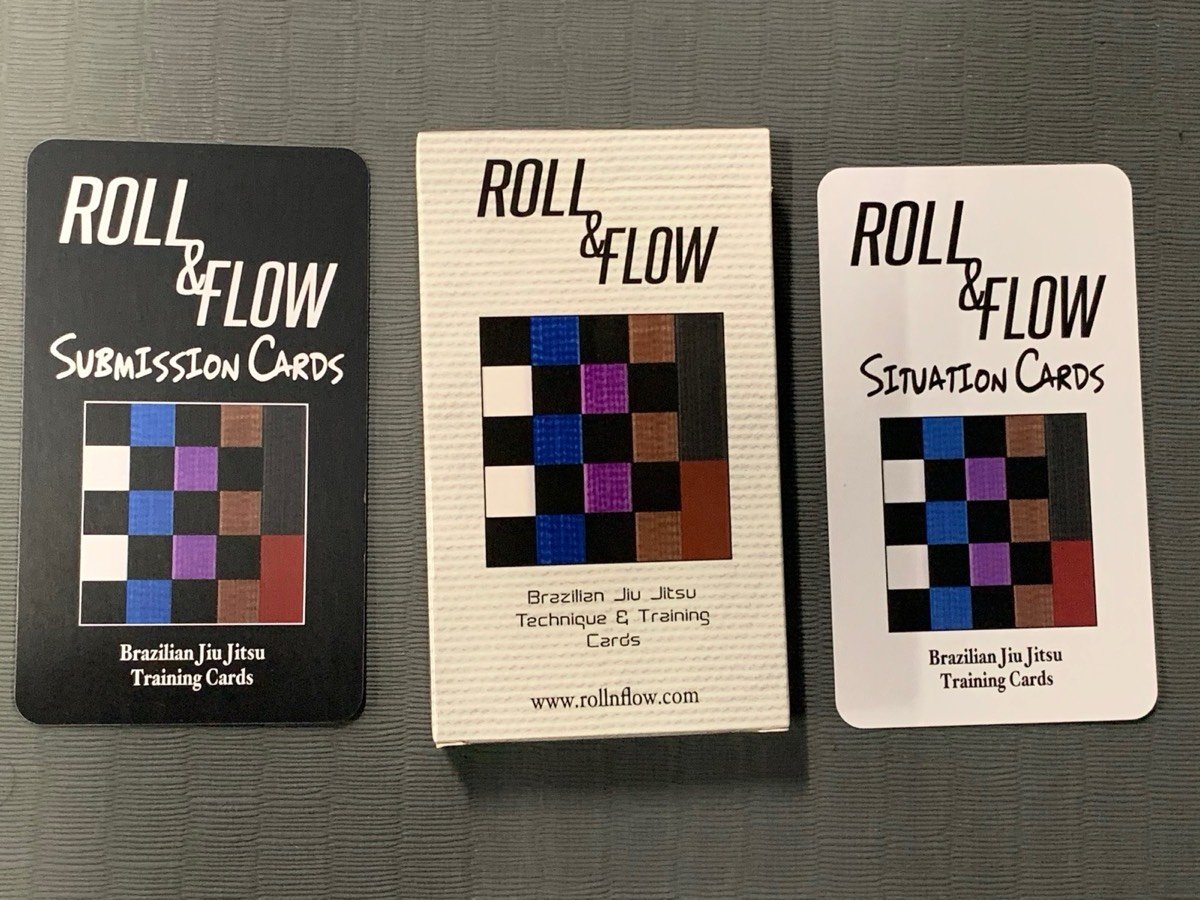
The weakness of every game above is that you pick the position — and left to choose, everyone picks what they're already good at. Randomizing the start position and the goal removes that bias. You can write positions on scraps of paper, or use a deck built for exactly this: Roll & Flow is a BJJ card deck where Situation cards set a random starting position and Submission cards hand each roller a secret objective. These three games run straight off it.
13. Position Roulette
Players: 2. Draw a Situation card — turtle, 50/50, back-against-the-wall mount, whatever fate deals — and start the roll exactly there. Roll to a finish or a 3-minute cap, draw again, repeat.
Trains: the 80% of positions your normal rolls never visit. After a month, you stop having "spots I've literally never been in."
Intensity: moderate. The randomness keeps it playful even when the rolling is hard.
14. Secret Submission Missions
Players: 2. Each roller draws a Submission card and keeps it hidden. You roll normally, but you can only win by finishing your secret submission. Reading your partner's setups — and disguising your own — becomes half the game.
Trains: setups, misdirection, and hunting a specific finish through resistance instead of taking whatever's floating around.
Intensity: moderate, and genuinely fun — this is the game people ask to run again.
15. Blind Draw (Full Deck)
Players: 2–4. Combine both: draw a Situation card for the start and a secret Submission card each. Now you're starting somewhere you didn't choose and hunting a finish you didn't pick. With four people, run it winner-stays with fresh draws every round.
Trains: everything at once — improvisation, positional breadth, and goal-directed rolling. It's the anti-autopilot game.
Intensity: scalable. This one turns a dead Sunday open mat into the session people text each other about.
How to Actually Run These at Open Mat
- Pick two or three games per session, not ten. One warm-up game (grip fighting, back attack survival), one main course (positional loops, card games), one finisher (shark tank).
- Keep rounds short. 2–4 minutes with fast resets beats 8-minute marathons. More resets means more reps at the part of the position that matters.
- Agree on the win condition out loud before you slap hands. Most game arguments are really just two people playing different games.
- Let lower belts win sometimes. If the constraint isn't making the roll competitive, tighten it. A game nobody can win teaches nothing.
Aimless rolling isn't wrong — it's just incomplete. Add structure to even a third of your open mat time and you'll feel the difference in a month. And if you want the structure to fit in your gi bag, grab a Roll & Flow deck — shuffle, draw, roll. Stop drilling. Start solving.
FAQ: Open Mat Games and Training
What do you do at a BJJ open mat?
Open mat is unstructured mat time: no formal instruction, just free rolling, drilling, or games with whoever shows up. Most people free roll the whole time, but the highest-value use is mixing free rolls with targeted work — positional sparring, specific games, or troubleshooting techniques from the week's classes.
How do I make open mat more productive?
Show up with one specific goal — a position to fix or a submission to hunt — and build at least a third of your rolls around it using games like positional loops or secret submission missions. Randomized starting positions (drawn from cards or picked by a partner) also stop you from defaulting to your comfort zone every roll.
Are games better than drilling in BJJ?
They solve different problems. Drilling builds the raw movement; games force you to apply it against resistance, with timing and decision-making attached. The constraint-led approach argues games alone are enough; most gyms land on a mix. Either way, games are strictly better than aimless free rolling for targeting weaknesses.
Can white belts play these open mat games?
Yes — several of these games are actually safer for beginners than free rolling. Grip fighting only, catch and release, the floor is lava, and back attack survival are all low-impact with clear rules. Handicap rolls are the best way for a white belt to get a competitive, useful roll with a much higher belt.
How many rounds should you roll at open mat?
Quality beats volume. Five to eight focused rounds of 4–6 minutes is plenty for most people; add short-round games like king of the hill or 10-second pin if you want more mat time without more wear. If you're grinding out 15 identical rounds on autopilot, you're building fatigue, not skill.
Related reading: How to Run Positional Sparring (Formats, Timers, and 12 Starting Positions) · BJJ Warm-Up Games That Aren't a Waste of Time · How to Structure a BJJ Class · Solo BJJ Drills Without a Partner · Randori vs. Positional Sparring · No-Gi Warm-Up Games · Best Games for BJJ Kids Classes · How to Stop Drilling the Same 3 Moves